Rollator vs Walker: Which Is Right for You?
Affiliate disclosure: This article contains affiliate links. If you buy through a link on this page, we may earn a small commission at no extra cost to you. Our recommendations are based on the features that matter for everyday use, and a commission never changes which products we include. Affiliate links in this article are marked `rel=”sponsored nofollow”` and use the placeholder [AMAZON ASSOCIATES ID] until live affiliate links are confirmed.
If you are choosing between a rollator and a walker, you are not alone. It is one of the most common questions people ask when they start shopping for a mobility aid, and it is a good question, because the two look similar but behave very differently when you use them.
The short answer is this: a walker gives you more support with every step, while a rollator gives you more freedom to keep walking, plus a seat when you need a rest. Which one is right for you depends on your balance, your strength, and how far you want to walk.
This guide explains the difference in plain language, compares the two side by side, and helps you decide which one fits your daily life. It does not claim one is better than the other for everyone, because there is no single right answer. The right aid is the one that matches how you move.
Quick-pick summary
| If this sounds like you | Choose | Why |
|---|---|---|
| You need steady support with every step | Standard folding walker with wheels | It stays in front of you, it is simple, and it is the steadiest option |
| You walk well but tire easily | Four-wheel rollator with seat and basket | Seat, basket, and brakes for longer walks |
| You are coming home after surgery | Folding walker first, rollator later | Start steady, switch when your strength returns — ask your therapist |
| You need help on outings from a companion | Folding transport wheelchair | For days when walking the whole way is too much |
| You only need light balance help | Adjustable walking cane | Simplest and lightest, for short walks |
What is a walker?
A standard walker is a light metal frame you stand inside. The most common type for seniors has two front wheels and two rear glides. You push it forward a short step, then step forward into the frame. It stays in front of you the whole time, which is what makes it so steady.
A folding walker with wheels is light, folds flat for storage and car transport, and has height-adjustable legs so the handles sit at wrist height. It works best on flat indoor floors and smooth pavements. It has no seat and no brakes, because it does not roll freely — you control it with every push.
Walkers suit people who need support with each step, people who are unsteady on their feet, and people coming home after a hospital stay or surgery who need to move slowly and carefully. They are also the simplest type to learn, which matters when you are tired or in pain and do not want to learn a new skill.
The main limit is distance. Without a seat, you need a chair nearby when you get tired. And because you push it step by step, it is slower than a rollator on longer walks.
What is a rollator?
A rollator is a walker with four wheels, hand brakes, and a seat. You push it ahead of you as you walk, and it rolls freely. The brakes slow you down on slopes and lock the wheels when you stop. When your legs feel tired, you lock the brakes, turn around, and sit on the padded seat for a few minutes.
Most rollators also have a basket or bag under the seat, so you can carry shopping, a purse, or a bottle of water with your hands free. They fold for storage and car transport, and the handle and seat heights adjust to suit the person using them.
Rollators suit people who can walk reasonably well but tire easily, people who want to walk further than they do now, and people who like the idea of a seat that is always with them. They need a little more balance than a standard walker, because the wheels roll freely and you control the speed with the brakes.
Rollator vs walker: side-by-side comparison
| Feature | Standard walker | Rollator |
|---|---|---|
| Wheels | Two front wheels, rear glides | Four wheels |
| Brakes | None | Hand brakes, with a lock |
| Seat | No | Yes, padded |
| Basket or bag | No | Yes, usually |
| Support per step | High — frame stays in front of you | Moderate — rolls freely |
| Best for | Steady support, recovery, poor balance | Longer walks, shopping, days out |
| Weight | Usually lighter | Usually a little heavier |
| Turning space | Needs less room | Needs a little more room |
| Folding | Folds flat | Folds, sometimes less flat |
| Learning curve | Very simple | Simple, but practise the brakes first |
How to decide: five questions to ask yourself
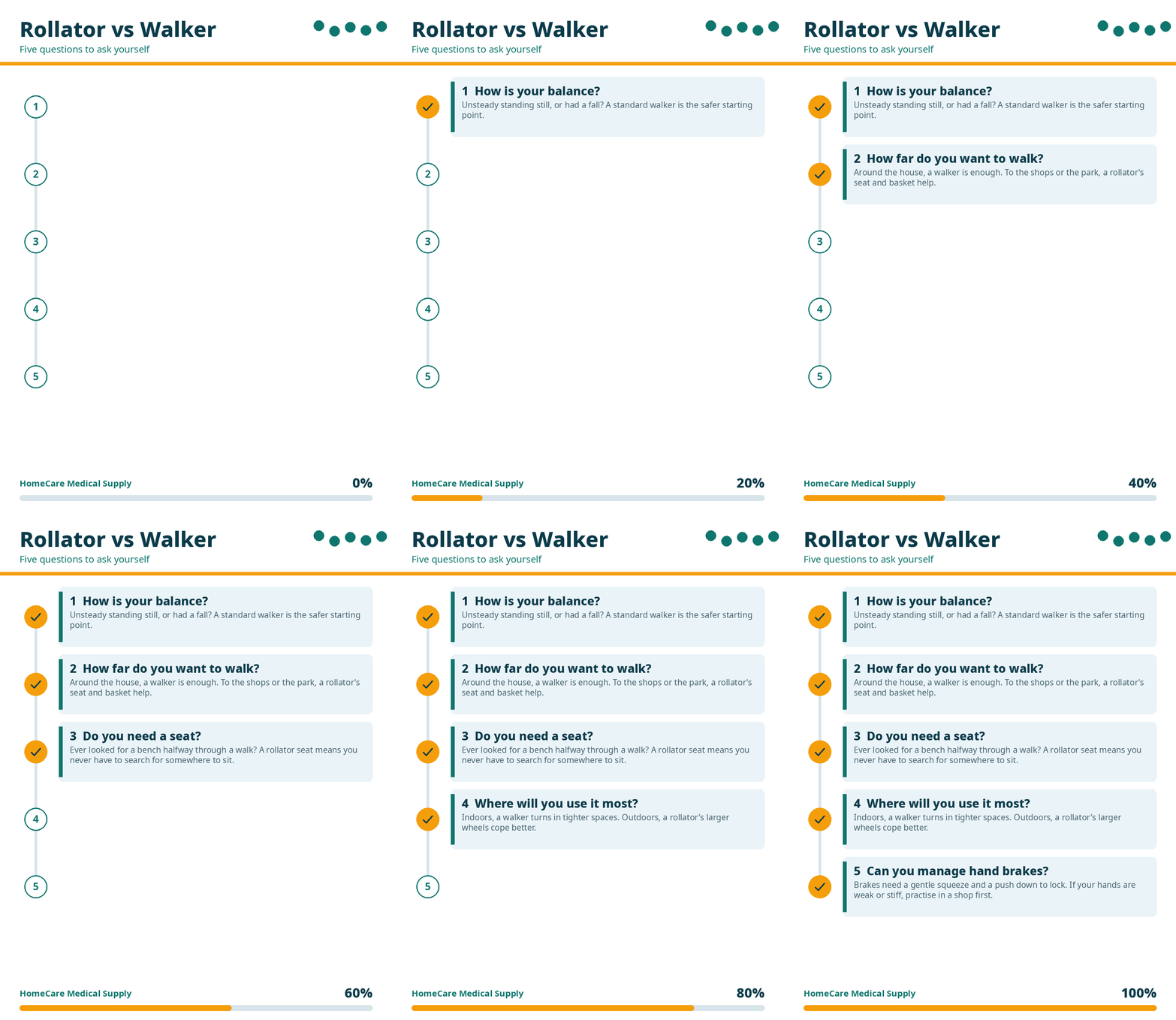
1. How is your balance? If you feel unsteady standing still, or you have had a fall, a standard walker is usually the safer starting point. Its frame stays in front of you and does not roll away. If your balance is reasonable and you mainly tire on longer walks, a rollator is worth trying. Be honest with yourself here, and ask your doctor or physical therapist if you are unsure.
2. How far do you want to walk? For moving around the house and short trips to the car, a walker is enough. For walks to the shops, the park, or a family visit, a rollator’s seat and basket make the trip much easier. Think about your longest regular walk, not your shortest.
3. Do you need a seat? If you have ever had to look for a bench halfway through a walk, the answer is yes. A rollator seat means you never have to search for somewhere to sit. If you never tire on walks, a walker without a seat is lighter and simpler.
4. Where will you use it most? Indoors, a standard walker turns in tighter spaces and is easier to manage in small rooms. Outdoors, a rollator with larger wheels copes better with pavements and paths. If you will use it in both places, check the wheel size and the width against your narrowest doorway.
5. Can you manage hand brakes? Rollator brakes need a gentle squeeze and a push down to lock. If your hands are weak or stiff, practise in a shop first. If the brakes feel hard to use, a standard walker, which needs no brakes at all, is the better choice.
What about after surgery?
Many people first need a walker after surgery, especially after a hip or knee replacement, when they have been told to move slowly and keep weight off one leg. A standard folding walker is the usual starting point in that situation, because it gives steady support with every step.
As strength returns, some people switch to a rollator for longer walks, and later to a cane for light support. That is a normal progression, not a failure. Your physical therapist can tell you when it is safe to change, and they can check your walking with each type. Do not switch on your own if you are still unsteady — the timing matters, and your therapist can see things you cannot feel.
Our recovery guide, Home Setup After Hip Replacement, covers the other equipment that helps during recovery, including a shower chair, a raised toilet seat with handles — see Hospital Beds & Daily Living and Bathroom Safety — and a hip replacement recovery kit.
Common mistakes when choosing
The most common mistake is buying a rollator when a walker would be safer, because the rollator looks more comfortable. Comfort matters, but steadiness matters more. If you have fallen, or you feel unsteady when you stand, start with a walker.
The second mistake is the opposite: buying a walker without a seat when you regularly tire on walks, then leaving it at home because it does not help you go far enough. If you stop using your walker, it is not helping you. A rollator you actually use is better than a walker that stays in the cupboard.
The third mistake is skipping the height check. A walker set too low makes you hunch. A walker set too high makes your shoulders ache. Stand upright, let your arms hang relaxed, and set the grips at wrist height. Ask a therapist to check it if you can.
Pros and cons at a glance
Standard folding walker with wheels Pros: steadiest support, simplest to use, light, folds flat, no brakes to learn. Cons: no seat, slower on long walks, less suited to rough ground.
Four-wheel rollator with seat and basket Pros: seat always with you, basket for shopping, good for longer walks, hand brakes for control. Cons: needs more balance, needs more room to turn, a little heavier, brakes take practice.
Our Top Pick
Our Top Pick — It depends on your balance, and here is how to choose. If your balance is poor, you have had a fall, or you are recovering from surgery, choose the lightweight folding walker with wheels. It is the steadiest, simplest option, and it is the right starting point. If your balance is reasonable and you tire on longer walks, choose the four-wheel rollator with seat and basket. The seat and basket will help you walk further and stay out longer. If you are still unsure after reading this guide, that is normal — ask your physical therapist to watch you walk with both types. A ten-minute check in a clinic is worth more than a week of guessing at home.
Product cards
Lightweight folding walker with wheels — Shop: Lightweight folding walker with wheels · Category: Mobility Aids Steady support with every step, folds flat, light to push. Best for poor balance and recovery. [Check Price — Amazon Associates ID: [AMAZON ASSOCIATES ID] — rel=”sponsored nofollow”]
Four-wheel rollator with seat and basket — Shop: Four-wheel rollator with seat and basket · Category: Mobility Aids Seat, brakes, and basket for longer walks. Best for people who tire easily but walk well. [Check Price — Amazon Associates ID: [AMAZON ASSOCIATES ID] — rel=”sponsored nofollow”]
Adjustable walking cane with ergonomic grip — Shop: Adjustable walking cane with ergonomic grip · Category: Mobility Aids Light balance support for short walks. Best as a later step, after a walker or rollator. [Check Price — Amazon Associates ID: [AMAZON ASSOCIATES ID] — rel=”sponsored nofollow”]
Frequently asked questions
Q: What is a rollator walker?
A: A rollator is a walker with four wheels, hand brakes, and a built-in seat. You push it ahead of you as you walk, and you can sit on the seat whenever you need a rest.
Q: Is a rollator better than a walker?
A: Neither is better for everyone. A rollator is better for longer walks, shopping, and resting on the go. A walker is better for steady support with every step, poor balance, and recovery after surgery. The right choice depends on your balance and how far you walk.
Q: Can I use a rollator if I have poor balance?
A: It depends on how poor your balance is. Rollators roll freely, so they need more balance than a standard walker. If you feel unsteady standing still or you have had a fall, a standard walker is usually safer. Ask your physical therapist to check you with both types.
Q: Do rollators have brakes?
A: Yes. Rollators have hand brakes that you squeeze to slow down and push down to lock. Always lock the brakes before you sit on the seat. Practise the brakes in a safe place before your first walk out.
Q: Can I take a rollator on a plane or in a car?
A: Most rollators fold for car transport, and many fit in a car boot. For planes, check with the airline before you travel, as rules vary and you may need to check it in. A standard folding walker is usually lighter and easier to fold for travel.
About the author: This guide was written by the homecaremedicalsupply.com/ Editorial Team. [Author bio placeholder — name, role, and credentials to be added before publishing. Do not publish with a named author until confirmed.]
Last updated: 27 Nov 2026
Medical disclaimer: This article is informational only and is not medical advice. It does not replace advice from a doctor, nurse, physical therapist, or other qualified healthcare professional. Always consult a healthcare professional before choosing or using a walker, rollator, or any mobility aid.